
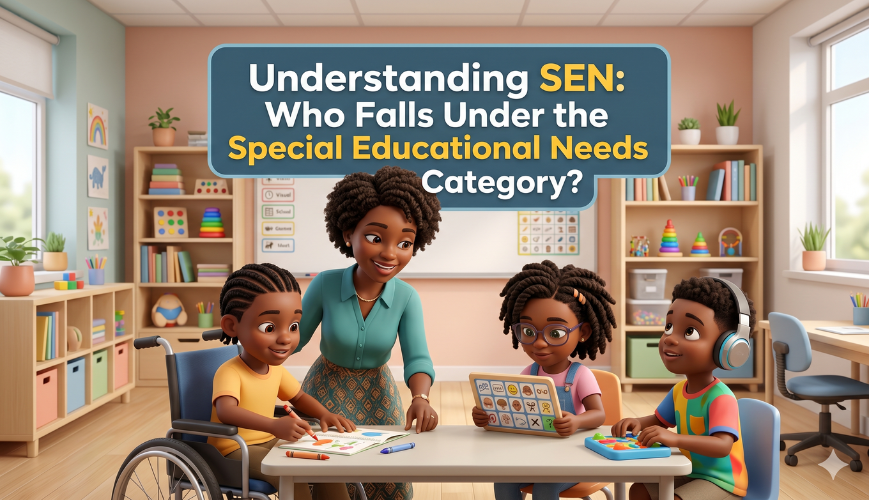
Every child learns in their own unique way. While some students progress with minimal assistance, others may need additional guidance, adjustments, or specialized support to fully reach their academic, social, and personal potential. This is where Special Educational Needs (SEN) becomes essential.
But what exactly does SEN mean, and who falls under this category?
Special Educational Needs refers to children or young people who have a learning difficulty, developmental challenge, disability, or condition that requires extra educational support beyond what is typically provided in a regular classroom setting. SEN is not about limitation it is about recognizing differences and ensuring that every learner has equal opportunities to succeed.Generally, these needs are grouped into four primary areas:
Children in this category may struggle to communicate with others. This includes difficulties in saying what they want to, understanding what is being said to them, or understanding social rules of communication. This area often includes students with Speech, Language, and Communication Needs (SLCN) and those on the Autism Spectrum.
This encompasses a wide range of needs. Some children learn at a slower pace than their peers, even with appropriate differentiation. This can range from Moderate Learning Difficulties (MLD) to Profound and Multiple Learning Difficulties (PMLD). It also includes Specific Learning Difficulties (SpLD), which affect one or more specific aspects of learning, such as dyslexia (reading), dyscalculia (math), or dyspraxia (coordination).
Children may experience a wide range of social and emotional difficulties which manifest in many ways. These may include becoming withdrawn or isolated, as well as displaying challenging, disruptive, or disturbing behavior. Conditions such as Attention Deficit Hyperactivity Disorder (ADHD) or attachment disorders fall under this umbrella.
Some children require special educational provision because they have a disability that prevents or hinders them from making use of the educational facilities generally provided. This includes vision impairment (VI), hearing impairment (HI), multi-sensory impairment (MSI), and various physical disabilities (PD).
Recognizing that a child has SEN is the first step toward unlocking their potential. By identifying these specific needs, educators and parents can collaborate to create a tailored, supportive environment where every student is empowered to thrive.
1 comments
Joelene Ankrah
Woow I didnt Know this